Desk Yoga for People Who Hate Yoga
A field guide for anyone whose hips have quietly fused to an Aeron chair, written by someone who’s spent fifteen years teaching the people who would never set foot in a studio.
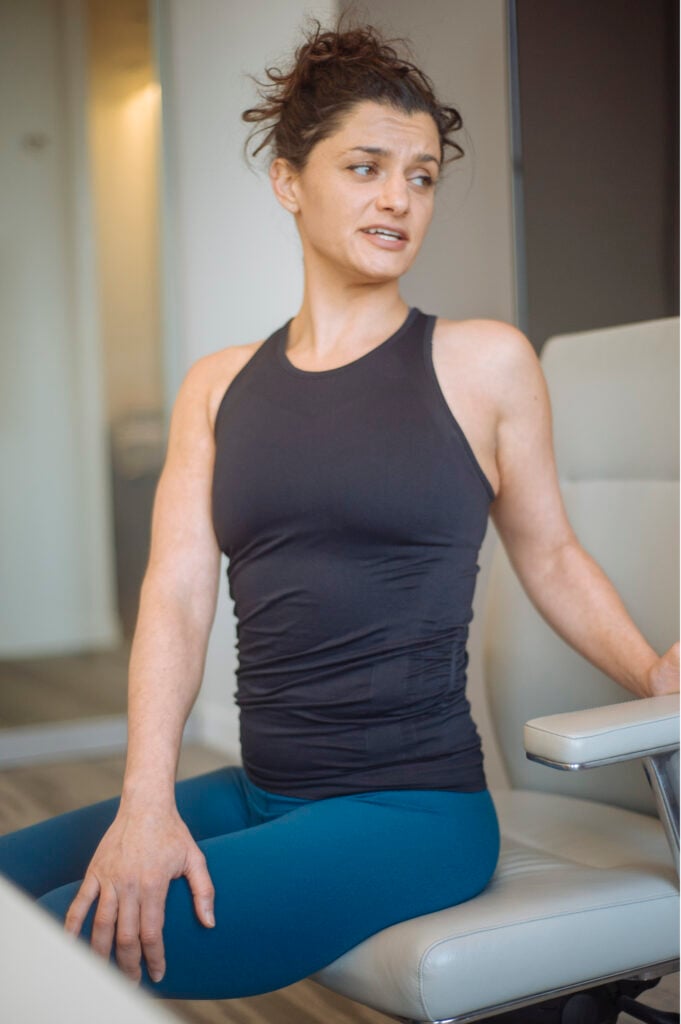
Laura is a senior product manager at a fintech startup I’ve been teaching at since 2019. Laura’s boss makes her join. In her quiet protest, she has never, not once in five years, uncrossed her arms during my warm-up. When I demonstrate a shoulder roll, she watches me the way my dog watches a vacuum cleaner. She doesn’t speak. She doesn’t stretch more than 40 percent of the way into anything. And yet Laura has come to every single session, including the one on the day her product launch was due.
Last month, Laura walked up to me after class and said, “My neck doesn’t hurt anymore.”
That was the whole sentence. Then she walked away.
Laura is the reason I wrote this. Laura, and all the people who would rather schedule a meeting with themselves than walk into a yoga studio. The eye-rollers. The arm-crossers. The ones who hear the word “yoga” and immediately picture incense, Sanskrit, a flexibility test they’ll fail, and a person in stretch pants asking them to honor their breath. That is not what we do here. That is not what this article is about.
If you’ve quietly decided yoga isn’t for you, fine. I’m not going to argue with you. I just want twelve minutes of your time and the chair you’re already sitting in.
What Desk Yoga Actually Is
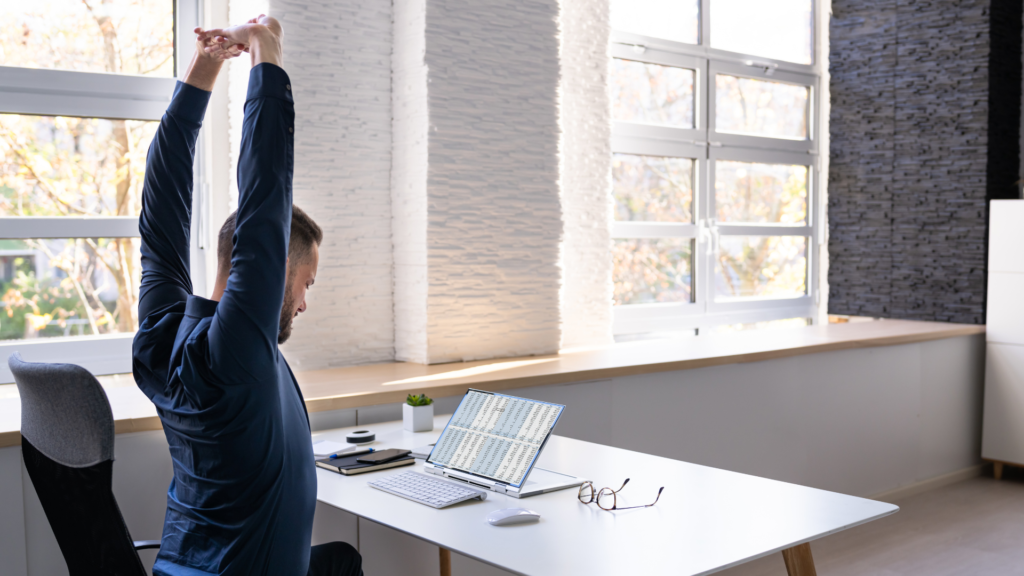
I share Office Yoga tips and sequences in our newsletter here.
Desk Yoga is not a spiritual practice. It’s not a workout. It is body maintenance for a job that’s quietly destroying you.
I know that sounds dramatic. I am being completely literal. The job you have: the screen, the chair, the meetings, the leaning forward to read a 9-point font, is slowly rearranging your body. Your hip flexors are getting shorter. Your shoulders are migrating up toward your ears. I even bet your tongue is pressed up against the roof of your mouth right now. None of this is your fault. It’s just what eight hours of sitting does.
Loving yoga is not required to undo tension. You don’t need to believe in reincarnation or astrology. You just need to interrupt the pattern, often enough, for long enough, that your body stops settling into the shape of a folding chair.
The 3 Reasons You’ve Avoided This So Far

I’ve taught Desk Yoga to 475+ companies, which means I’ve heard every objection there is. There are basically three.
“I’m not flexible enough.” This is the most common, and it is also painfully backward. Saying you’re not flexible enough for yoga is like saying you’re too dirty to take a shower. The thing is the thing that fixes the thing. Also, nothing I’m asking you to do requires flexibility. You will not be folding in half or touching your toes. You will be doing approximately what you’d do if I told you to stretch before a long drive, except you won’t have to leave your chair.
“I don’t have time.” Five minutes. That’s the whole pitch. If you don’t have five minutes, you have a different problem, and yoga isn’t going to fix that one.
“It’s not really my thing.” This is the polite version, and underneath it is usually the real one: I don’t want to look stupid in front of my coworkers. Fair. So don’t do this in front of your coworkers. Close the door. Mute the meeting. Lock yourself in a bathroom stall. The whole point of Desk Yoga is that nobody has to know.
The 5-min Maintenance Sequence

I share office yoga sequences and more in training here.
Here is what to do. No mat, no floor, or changing clothes. No commitment to anything beyond the next five minutes.
Minute 1 — Seated cat-cow.
Sit at the front of your chair, feet flat, hands on your thighs. Inhale: lift your chest and roll your shoulders back. Exhale: round your spine and tuck your chin toward your chest. Eight rounds. This wakes up the spine, which has been holding the shape of your laptop since 9 a.m.
Minute 2 — Shoulder rolls and one chest opener.
Five big shoulder rolls back. Then interlace your fingers behind your back, straighten your arms, and lift your chest toward the ceiling. Three breaths. Try to look mildly bored, in case anyone walks by.
Minute 3 — Seated twist, both sides.
Sit tall. Place your right hand on the outside of your left thigh, left hand on the back of your chair. Inhale, lengthen. Exhale, twist. Three breaths. Switch sides. This one tends to make people audibly exhale, which is fine. Audibly exhaling is allowed.
Minute 4 — Neck release.
Drop your right ear toward your right shoulder. Rest your right hand on the left side of your head. Don’t pull; just let the weight of your hand be the stretch. Three breaths. Switch sides. If you can feel a faint line of tension running from your skull down into your shoulder blade, congratulations: you just located where most office headaches live.
Minute 5 — One round of Calming Breath.
Inhale through your nose for four counts. Exhale through your nose for four counts. Repeat for one full minute. That’s it. That is the whole nervous system intervention. The Navy SEALs use a version of it. So do anesthesiologists. So can you, between Slack messages.
That’s five minutes. Do that, once a day, on a Tuesday. Then again on Wednesday. See what happens.
Quick aside, for the yoga teachers and enthusiasts who somehow ended up reading a post that’s actively making fun of yoga: sequences like the one above, taught to people who’d never set foot in a studio, are most of what we teach in the Office Yoga Teacher Training. It’s the niche that took me from “barely paying rent in a studio” to a real career in conference rooms. If that’s you, come find us.
What You Will (and Won’t) Feel in Week One
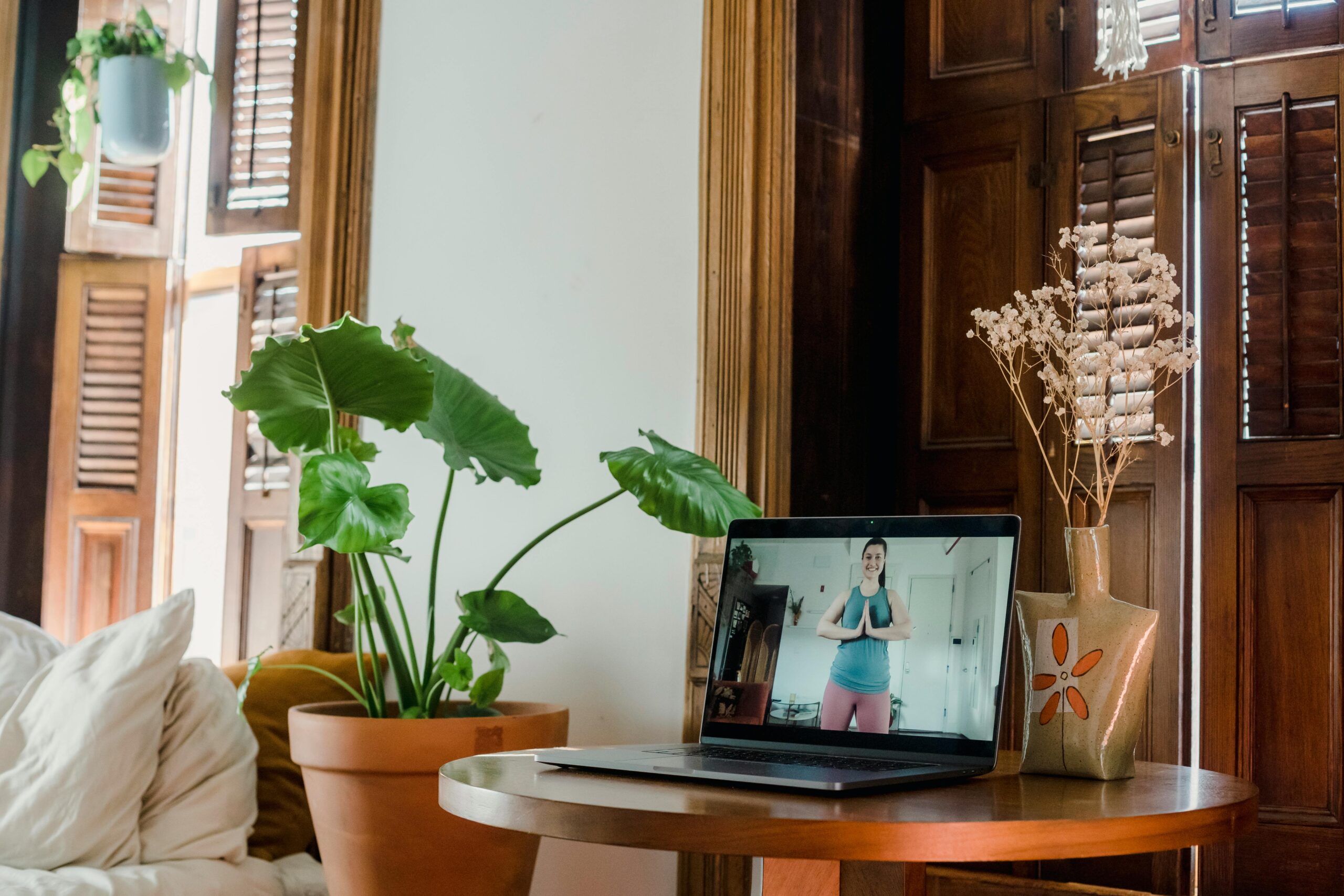
You will not feel enlightened. You will not feel “centered.” After one session, you will not suddenly understand why people post photos of themselves doing tree pose on mountaintops.
What you’ll probably feel, by day three or four, is this: somewhere in the middle of the afternoon, you’ll notice that the band of tension you’ve been carrying behind your eyes is slightly looser. You’ll roll your shoulders without being told to. You’ll catch yourself taking a deeper breath in the elevator. Small things. Quiet things.
Within a couple of weeks, the people who keep going usually report three specific shifts: their neck and shoulder pain lessens, they sleep better at night, and they feel less tired in the late afternoon. That’s not magic. That’s just what happens when you stop holding your body in the same locked position for ten consecutive hours.
If you’ve been waiting for a transformation, I’m sorry to disappoint. Desk Yoga is not a transformation. It is maintenance. It’s brushing your teeth. It’s flossing. It is deeply unsexy. It’s taking care of the body you’re going to be in for the rest of your life.
The Permission Slip
You don’t have to like this. You don’t have to “get into yoga.” Leggings are not required, nor is talking about chakras or becoming a more spiritual person. You can roll your eyes through the whole thing. You can do it grudgingly, the way you take a vitamin.
The body doesn’t care whether you believe in yoga. It only cares whether you move it.
Laura, the product manager who has never uncrossed her arms during a warm-up, has been a Desk Yoga student for five years. She still does not like yoga. She has told me this directly, more than once. But her neck doesn’t hurt anymore. And every Wednesday at 10 a.m., she shows up.
That’s all I’m asking. Show up. Five minutes. Roll your eyes (and your wrists while you’re at it).
If you liked this (or hated it slightly less than you expected to), I send one practical sequence like this every Wednesday. No chanting. No incense. Flexibility is not required. Subscribe to the Office Yoga newsletter.
And if you’re a yoga teacher who’d rather work in conference rooms than studios, that’s what we train people to do. Office Yoga Teacher Training.